
YBYRÁ is now archived — its tools live on in Péva
YBYRÁ retires, and Péva carries the torch
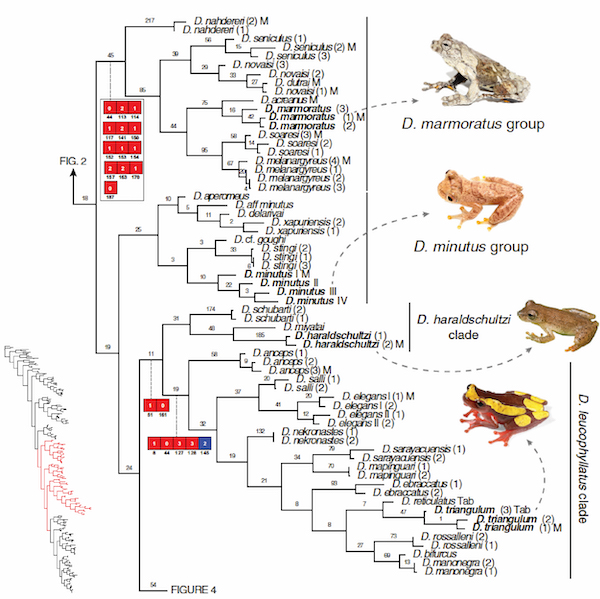
After many years of service to the phylogenetics community, YBYRÁ is no longer maintained. We are keeping its GitLab repository online and archived for historical reference and reproducibility, but active development has ended. For all of the analyses YBYRÁ used to handle, we now recommend our new platform, Péva.
What YBYRÁ did
YBYRÁ was a collection of tools for analyzing the results of phylogenetic analyses. Over the years it helped researchers:
- Categorize characters and synapomorphies to understand which characters support which clades.
- Run clade sensitivity analyses to see how robust groupings are to changes in data and parameters.
- Compute topological (tree-to-tree) distances to quantify how different trees are from one another.
- Detect wildcard taxa — the unstable, “rogue” terminals that jump around between trees and obscure otherwise well-supported relationships.
Why this is better inside Péva
Rather than maintaining a set of separate scripts, we have rebuilt and modernized YBYRÁ’s core capabilities inside Péva, our actively developed phylogenetics platform. Moving these tools into Péva means:
- One consistent home for character categorization, sensitivity analysis, tree-distance calculation, and wildcard detection, instead of a loose collection of utilities.
- Actively maintained code that continues to receive fixes, improvements, and new features.
- A unified workflow, so results from one analysis flow naturally into the next within a single, coherent platform.
If you were using YBYRÁ for any of the tasks above, Péva is the direct, better-supported replacement.
What else Péva does
Péva is more than a port of YBYRÁ — it is a broader phylogenetics platform that we continue to expand. Alongside the character categorization, sensitivity analysis, tree distances, and wildcard detection inherited from YBYRÁ, Péva brings these tools together in a modern, extensible framework designed to grow with the needs of the community.
A note on tree searches
To be clear: Péva is not yet recommended for tree searches. For heuristic tree searching we currently recommend Pablo Goloboff’s TNT and Ward Wheeler’s PhyG, both of which are excellent and well-established tools for that purpose.
That said, this is only the beginning. We are actively working on Péva and have exciting new functionality coming shortly. Stay tuned.
Previous post
Advancing FAIR phylogenetics for health threats
Next post
Two Posters, One Big Day at the Summer Research Symposium 2026