
Dr. Kary Ocaña Gautherot at the Larry Mays Bioinformatics Seminar Series
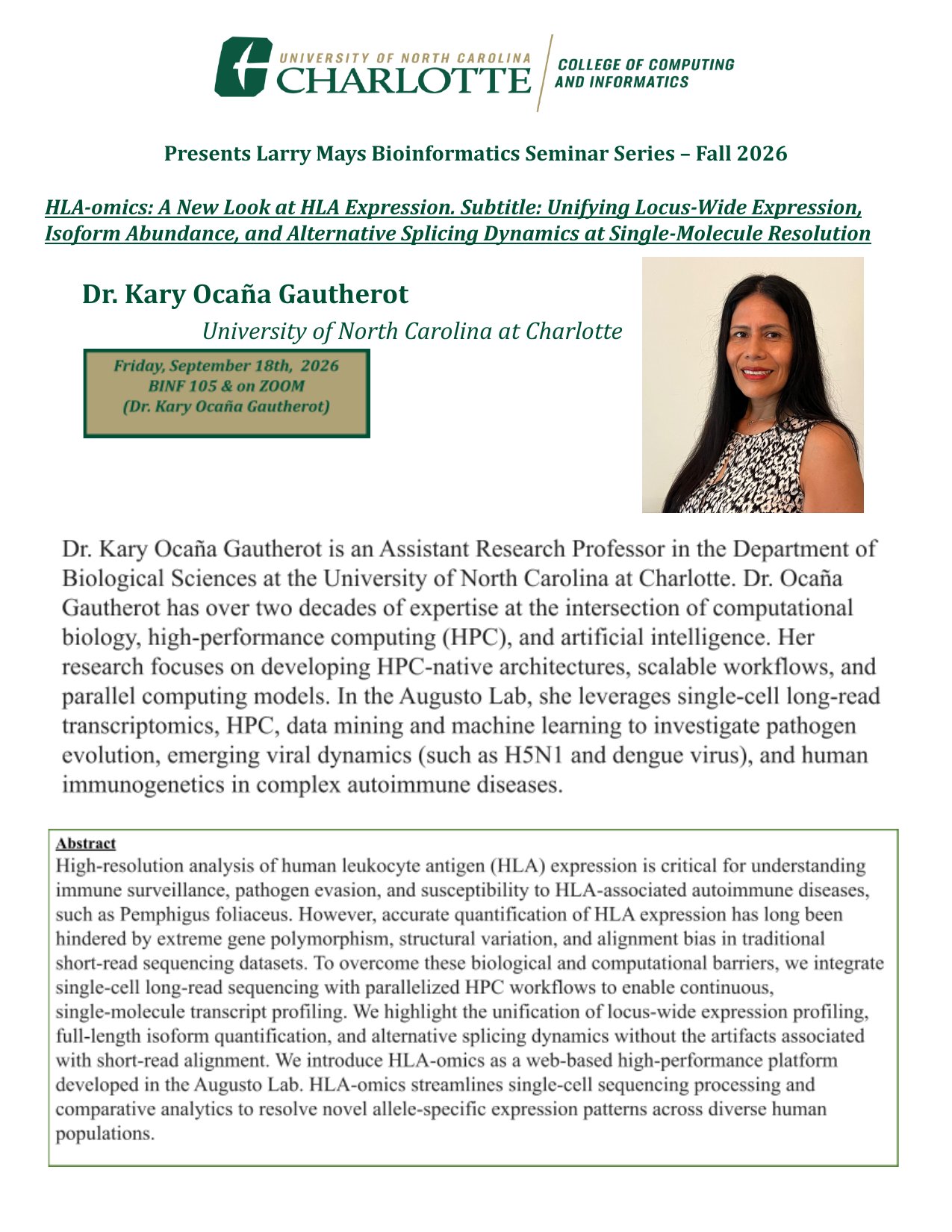
Join us today for HLA-omics
Today, Dr. Kary Ocaña Gautherot gives the Larry Mays Bioinformatics Seminar. Her talk is titled “HLA-omics: A New Look at HLA Expression. Unifying Locus-Wide Expression, Isoform Abundance, and Alternative Splicing Dynamics at Single-Molecule Resolution.”
- When: Friday, September 18, 2026
- Where: Bioinformatics Building, Room 105, UNC Charlotte, and on Zoom
- Who: everyone interested in bioinformatics, immunogenetics, and high-performance computing
Dr. Ocaña has been a close collaborator of our lab for years. We are glad to see her work on the seminar stage here at UNC Charlotte.
Introduction
Good afternoon, everyone, and welcome to the Larry Mays Bioinformatics Seminar Series. Today’s speaker is Dr. Kary Ocaña Gautherot.
Dr. Ocaña is an Assistant Research Professor in the Department of Biological Sciences here at UNC Charlotte. She has more than two decades of experience where computational biology meets high-performance computing and artificial intelligence.
Dr. Ocaña earned her doctorate and her master’s degree in Cellular and Molecular Biology at the Oswaldo Cruz Institute (Fiocruz) in Rio de Janeiro. She did her postdoctoral work in computer science at the Federal University of Rio de Janeiro. She then became a Full Researcher at the Brazilian National Laboratory for Scientific Computing (LNCC), home of the Santos Dumont supercomputer.
Her research builds HPC-native architectures, scalable workflows, and parallel computing models for biology. In the Augusto Lab, she uses single-cell long-read transcriptomics, HPC, data mining, and machine learning. She applies these tools to pathogen evolution, to emerging viruses such as H5N1 and dengue virus, and to human immunogenetics in autoimmune diseases.
I have worked with Kary for several years. Together we have studied recombination in dengue virus and other flaviviruses, and we built HP2NET for phylogenetic network analysis on supercomputers. I can tell you she is one of the kindest and most generous colleagues you will ever meet.
Today she turns to the HLA genes. These genes help the immune system tell self from nonself. They are also among the most variable genes in the human genome. That variation makes HLA expression hard to measure with short reads. Her talk shows how single-cell long-read sequencing and parallel HPC workflows measure expression across the whole HLA locus, count full-length isoforms, and track alternative splicing in one analysis.
Please join me in welcoming Dr. Kary Ocaña Gautherot.
Abstract
High-resolution analysis of human leukocyte antigen (HLA) expression is critical for understanding immune surveillance, pathogen evasion, and susceptibility to HLA-associated autoimmune diseases, such as Pemphigus foliaceus. However, accurate quantification of HLA expression has long been hindered by extreme gene polymorphism, structural variation, and alignment bias in traditional short-read sequencing datasets. To overcome these biological and computational barriers, we integrate single-cell long-read sequencing with parallelized HPC workflows to enable continuous, single-molecule transcript profiling. We highlight the unification of locus-wide expression profiling, full-length isoform quantification, and alternative splicing dynamics without the artifacts associated with short-read alignment. We introduce HLA-omics as a web-based high-performance platform developed in the Augusto Lab. HLA-omics streamlines single-cell sequencing processing and comparative analytics to resolve novel allele-specific expression patterns across diverse human populations.
Previous post
A Good Week at the Phyloinformatics Lab
Next post
Island snakes and their parasites at Genética 2026