
Island snakes and their parasites at Genética 2026
Two posters from our snake genomes at the 71st Brazilian Congress of Genetics
Next week, our collaborators from Instituto Butantan and the University of São Paulo bring two posters from our joint snake genomics project to Genética 2026, the 71st Brazilian Congress of Genetics. The Sociedade Brasileira de Genética (SBG) organizes the congress, which meets in Florianópolis, Santa Catarina, from September 29 to October 2, 2026. This year’s theme is “One Century of the Gene: From Theory to Genomics”, and it fits our work well. Both posters start from the same long-read genomes, which we sequenced with Oxford Nanopore at UNC Charlotte, and then take them in two very different directions.
Giovanna Yumi Scorsim Omura, a Ph.D. candidate in our lab, and I are coauthors on both posters, together with Igor Salles de Oliveira, Giselle Pessanha Pessoa, Milton Yutaka Nishiyama Junior, and Maria José de Jesus Silva.
What happens to a genome on an island?
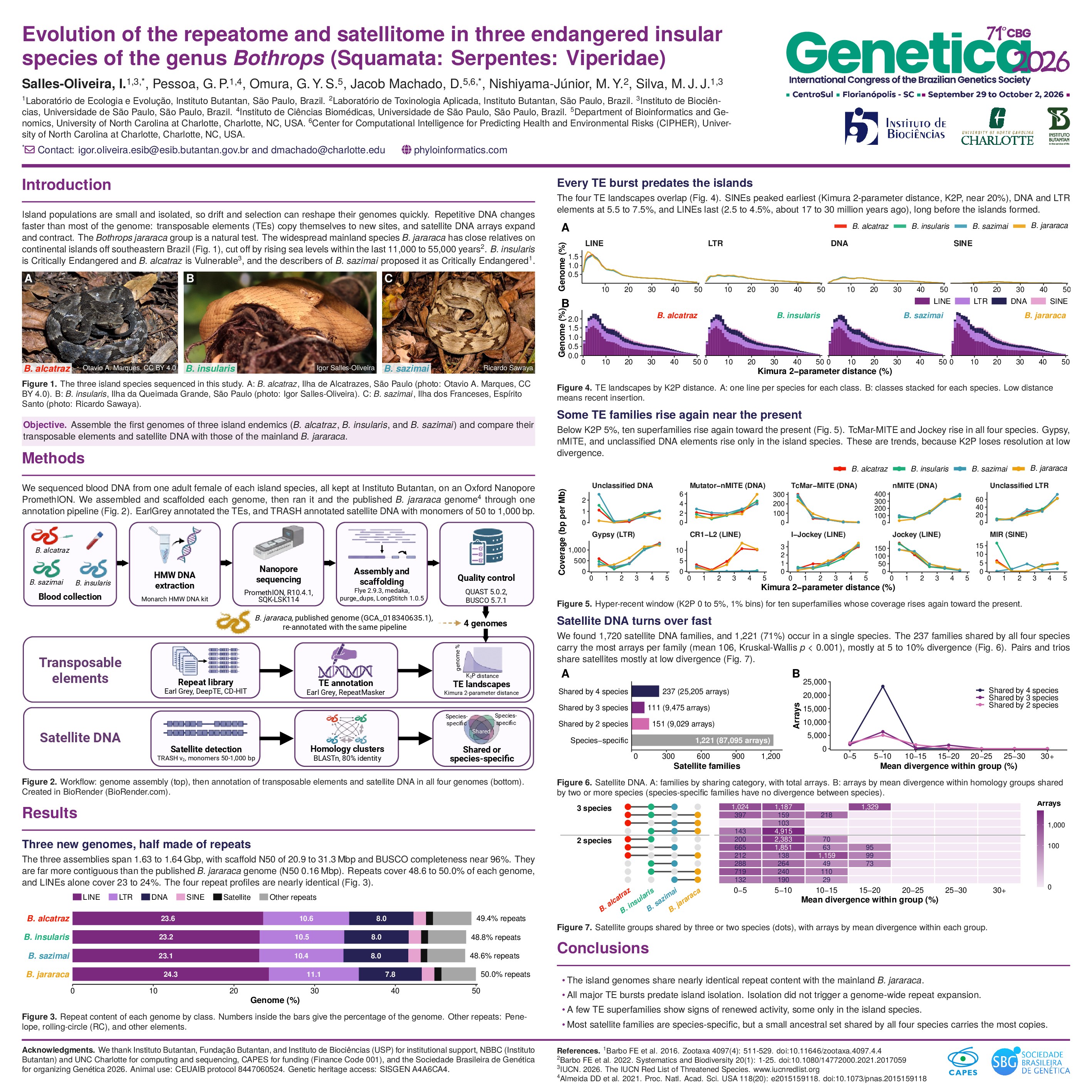
Three pitvipers of the Bothrops jararaca group live only on small islands off southeastern Brazil. Rising sea levels cut those islands off from the mainland within the last 11,000 to 55,000 years. We assembled the first genomes of B. alcatraz, B. insularis, and B. sazimai and compared their repetitive DNA with that of the mainland B. jararaca.
Repeats fill half of each genome, and the four repeat profiles are nearly identical. Every major burst of transposable elements happened millions of years before the islands formed. A few element families do show signs of renewed activity near the present, and some of them only in the island species. Satellite DNA tells a faster story: most of its 1,720 families occur in a single species, while a small ancestral set shared by all four species carries the most copies.
- When: Wednesday, September 30, 2026, from 17:00 to 19:00
- Presenter: Igor Salles de Oliveira
- Session: Genética Evolutiva, Trabalho #244
Poster, abstract, and LaTeX source on GitHub
A parasite hiding in a snake genome
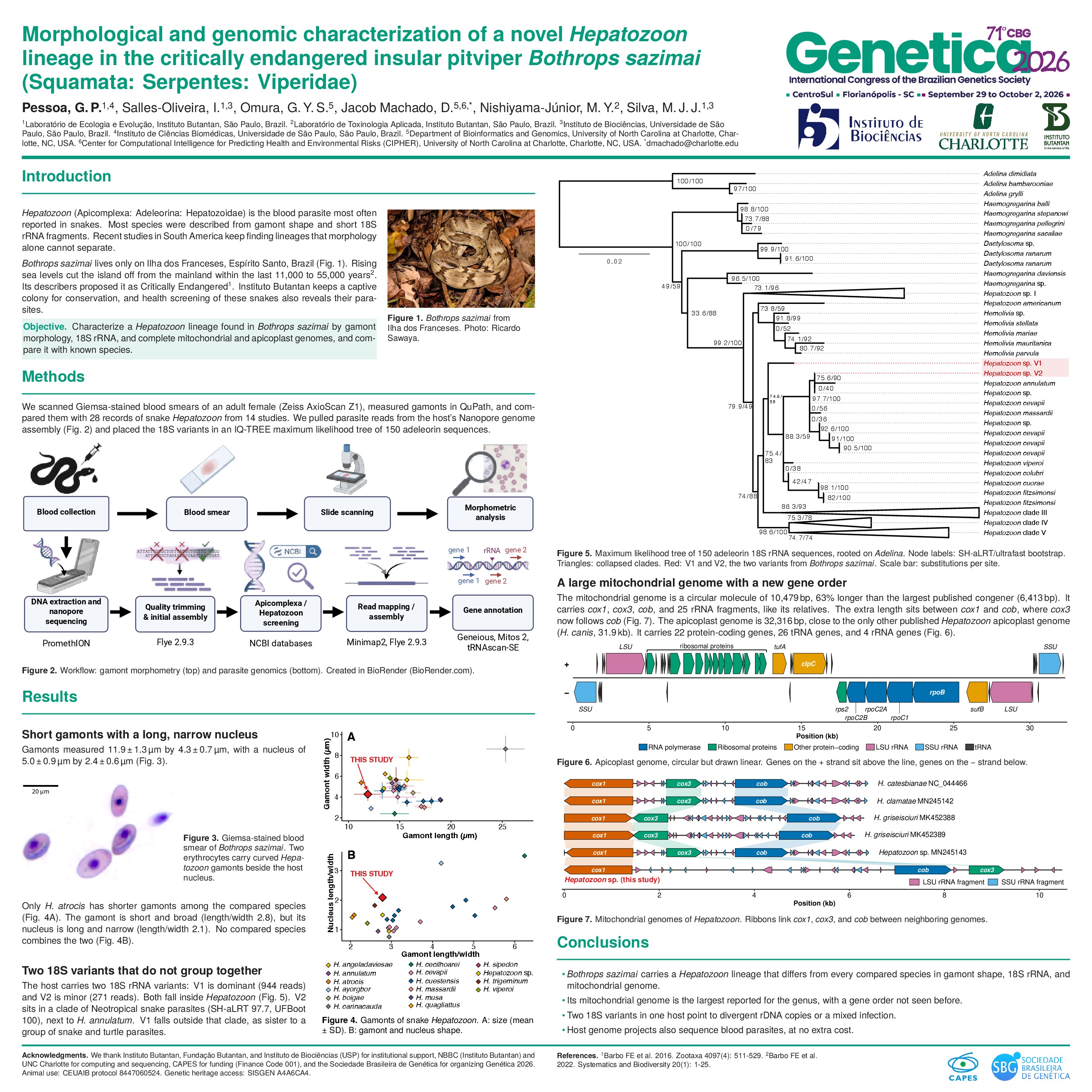
A genome project sequences everything circulating in the animal’s blood, not only the animal. While we cleaned the B. sazimai assembly, we found reads from Hepatozoon, the blood parasite most often reported in snakes. Instead of throwing those reads away, we assembled them.
The result is a Hepatozoon lineage that no described species matches. Its gamonts combine a short, broad body with a long, narrow nucleus. The host carries two 18S rRNA variants of the parasite. The mitochondrial genome is a circular molecule of 10,479 bp, 63% longer than any published Hepatozoon mitochondrial genome, with a gene order not seen before in the genus. We also recovered the complete apicoplast genome (32,316 bp). All of this came from data we had already generated, at no extra sequencing cost.
- When: Thursday, October 1, 2026, from 17:30 to 19:30
- Presenter: Giselle Pessanha Pessoa
- Session: Genética de Microrganismos, Trabalho #253
Poster, abstract, and LaTeX source on GitHub
How to cite this work
The congress publishes the accepted abstracts in its electronic proceedings. To cite the work, cite the accepted abstract:
Salles de Oliveira, I., Pessoa, G. P., Omura, G. Y. S., Jacob Machado, D., Nishiyama Junior, M. Y., and Silva, M. J. J. 2026. Evolution of the repeatome and satellitome in three endangered insular species of the genus Bothrops (Squamata: Serpentes: Viperidae). Abstract, Trabalho #244. 71º Congresso Brasileiro de Genética (Genética 2026), Sociedade Brasileira de Genética, Florianópolis, SC, Brazil.
Salles de Oliveira, I., Pessoa, G. P., Omura, G. Y. S., Jacob Machado, D., Nishiyama Junior, M. Y., and Silva, M. J. J. 2026. Morphological and genomic characterization of a novel Hepatozoon lineage in the critically endangered insular pitviper Bothrops sazimai (Squamata: Serpentes: Viperidae). Abstract, Trabalho #253. 71º Congresso Brasileiro de Genética (Genética 2026), Sociedade Brasileira de Genética, Florianópolis, SC, Brazil.
To cite a poster itself, cite its GitHub repository:
Salles-Oliveira, I., Pessoa, G. P., Omura, G. Y. S., Jacob Machado, D., Nishiyama-Júnior, M. Y., and Silva, M. J. J. 2026. Evolution of the repeatome and satellitome in three endangered insular species of the genus Bothrops (Squamata: Serpentes: Viperidae). Poster, Genética 2026, Florianópolis, SC, Brazil. https://github.com/machadodj/CBG71_Snakes
Pessoa, G. P., Salles-Oliveira, I., Omura, G. Y. S., Jacob Machado, D., Nishiyama-Júnior, M. Y., and Silva, M. J. J. 2026. Morphological and genomic characterization of a novel Hepatozoon lineage in the critically endangered insular pitviper Bothrops sazimai (Squamata: Serpentes: Viperidae). Poster, Genética 2026, Florianópolis, SC, Brazil. https://github.com/machadodj/CBG71_Hepatozoon
Both repositories hold the poster as a PDF, an updated abstract, and the LaTeX source, all under a Creative Commons Attribution-NonCommercial-ShareAlike 4.0 license. The congress does not allow changes to an abstract after submission, so the updated abstracts in the repositories carry the corrections and new results we added while preparing the posters.
Thank you
This work is a true collaboration between Instituto Butantan, the University of São Paulo, and UNC Charlotte. Thank you to Maria José de Jesus Silva and Milton Yutaka Nishiyama Junior for years of partnership, to Igor and Giselle for carrying the posters to Florianópolis, and to CAPES for funding. Thank you also to the Sociedade Brasileira de Genética for organizing Genética 2026. If you are at the congress, please stop by the posters and say hello to Igor and Giselle.
Previous post
Dr. Kary Ocaña Gautherot at the Larry Mays Bioinformatics Seminar Series
Next post
Two Péva Workshops at EVOLVE