
Wet Lab Signs: A Free Book of Signs and Tools for Shared Molecular Biology Labs
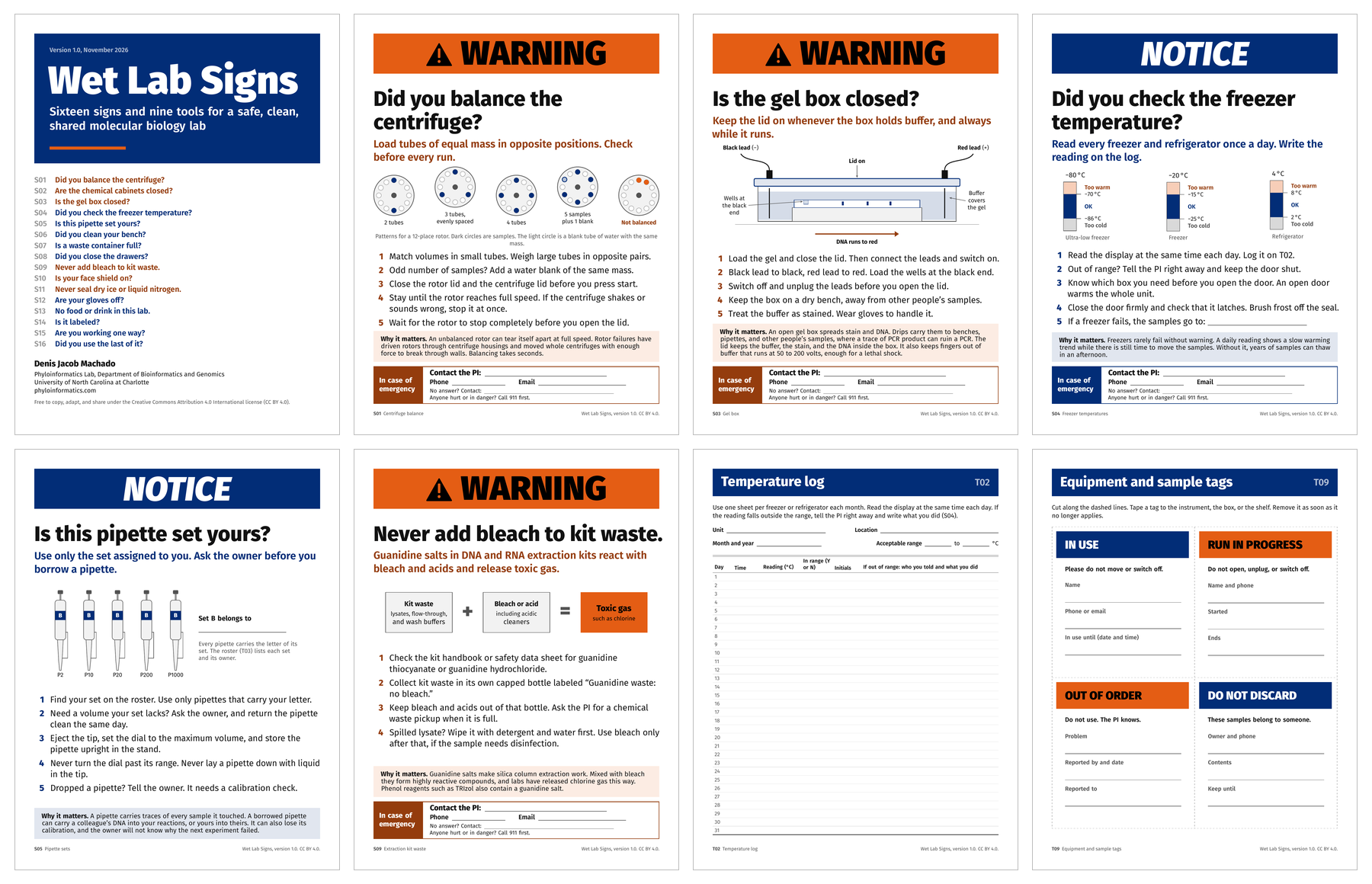
Signs for a lab that many people share
I made a book of signs for our wet lab, and any molecular biology lab can print it. Wet Lab Signs holds 16 signs and 9 tools in one free PDF. Each sign asks one question at the spot where the answer matters. Did you balance the centrifuge? Is the gel box closed? Did you check the freezer temperature? The steps follow in type you can read from across the room, and a short note at the bottom of each sign explains why the rule exists.
A shared lab works when everyone follows the same small habits. Several people share our benches and freezers, often at different hours. Most problems start small: a drawer left open, a pipette borrowed without asking, or a freezer nobody checked over the weekend. A sign puts the habit where people need it, and a log turns the habit into a record.
What the signs cover
Eight signs cover the daily habits I ask of everyone in our lab. Close the drawers. Keep the flammables and corrosives cabinets shut. Clean your bench. Tell the PI before any waste leaves the room. Keep the gel box closed. Balance the centrifuge. Use only your own pipette set. Check the freezer temperatures every day.
Eight more signs cover hazards that molecular biology labs know well. One warns against adding bleach to extraction kit waste, because the guanidine salts in many DNA and RNA kits react with bleach and release toxic gas. Others cover ultraviolet light at the gel imager, dry ice and liquid nitrogen, gloves on shared surfaces, food and drink, labels, the one-way PCR workflow, and shared supplies.
The nine tools make the signs work in practice. They include an emergency information sheet, a daily temperature log for each freezer, a pipette set roster, a waste log, and a weekly duty sheet that also records the eyewash test. The rest are an equipment booking sheet, a restock list, a last-person-out checklist, and cut-out tags for equipment and samples.
Two colors, one meaning each
An orange WARNING header marks a hazard that can hurt someone right away, such as a spinning rotor or a live power supply. A navy NOTICE header marks a practice that protects samples, equipment, and colleagues. The colors come from our lab palette and follow the logic of the ANSI Z535 safety signs. Every page also prints well in grayscale.
Print it for your lab
Print the pages you need on letter paper, laminate the signs, and post each one where the action happens. The contents page suggests a spot for each sign. Blank lines take your own phone numbers and temperature ranges. Fill them in by hand, or edit one settings file in the LaTeX source and recompile.
The last pages of the book list the sources behind each sign, from OSHA standards and the CDC and NIH biosafety manual to the safety offices of several universities. Your own institution’s rules come first wherever they differ. In 2024, UNC Charlotte’s Environmental Health and Safety office named our lab a Safety Champion. This book writes down the habits behind that recognition.
The book is free under a Creative Commons Attribution 4.0 license. Copy it, adapt it, and share it with credit.
Previous post
Phyloinformatics News: October 2026 AI Roundup
Next post
Advanced HPC Cluster Training on November 20