
Three Deadly Coronaviruses All Began in Bats
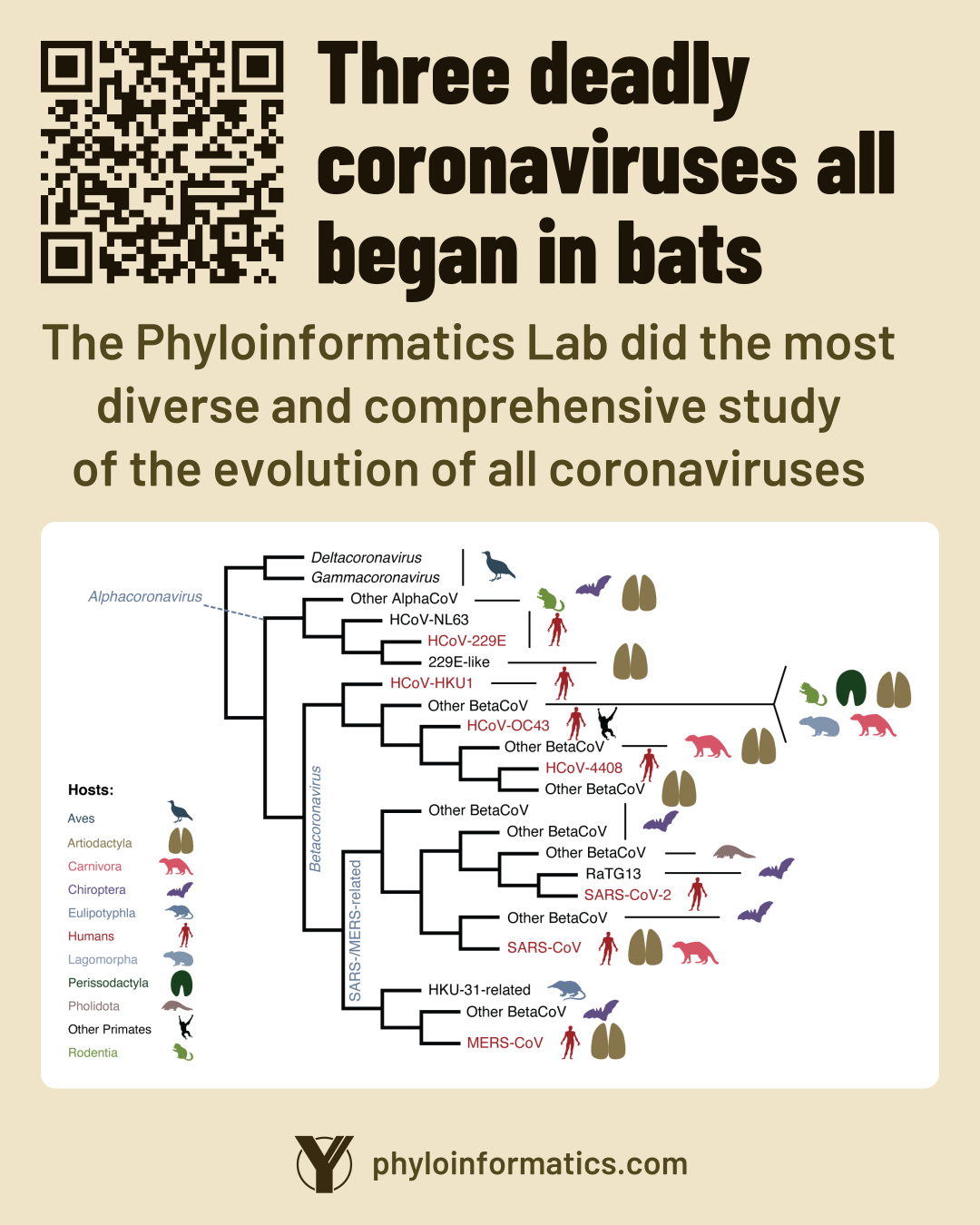
A family tree of 2,006 coronaviruses points to bats
SARS-CoV reached people in 2002, MERS-CoV in 2012, and SARS-CoV-2 in 2019. Each virus caused a deadly outbreak. Each one also descends from coronaviruses that live in bats. We showed this with a family tree of 2,006 complete coronavirus genomes, which Rachel Scott, Sayal Guirales, Daniel Janies, and I published in Cladistics.
How a family tree finds the source
A phylogenetic tree groups viruses by shared ancestry, the way a family tree groups relatives. We built ours from whole genomes. We used the gene annotations to line up each gene with its counterpart in every other virus, and then we analyzed all the genes together. The two groups of coronaviruses that started in birds served as the outgroup, the reference point that roots the tree. With the root in place, we traced how coronaviruses jumped between hosts across ten orders of animals.
The tree confirms that bat coronaviruses are the closest relatives of SARS-CoV, SARS-CoV-2, and the MERS-related viruses. It also counts the other jumps between animals, which shows where the risk of new human coronaviruses comes from. A second data set of 250 SARS-CoV-2 genomes clarified how the COVID-19 virus relates to its bat relatives.
Why the tree matters
New coronaviruses will keep jumping from animals to people. A tree we can trust tells us which hosts to watch and which viruses sit one step away from us. When a new coronavirus appears, a tree like this one is the first place we put it.
How this fits our lab
This paper shows what we mean by phyloinformatics. We join evolutionary trees, genomes, and machine learning to answer practical questions about the health of people, animals, and the environment. Viruses are the hardest test for these tools, so much of our work starts there. The same tools also read the genomes of poison frogs, island snakes, brittle stars, and museum specimens.
This post opens a weekly series. Each week we share one line of research from our lab, here and on our social media pages.
Read the paper in Cladistics See the journal cover we designed
Previous post
Srikritha Kosuri Takes AVOIDRUNE to SNCURCS 2026
Next post
Giovanna Yumi Scorsim Omura Defends Her Dissertation